
This article explains, in more detail, call statuses, indicator calculation rules, and how data export works in the WhatsApp calls report in Zenvia Customer Cloud.
It is recommended for users who need to:
Analyze data in greater depth.
Audit service interactions.
Understand why a call was classified as answered, missed, or failed.
WhatsApp voice call statuses
In the report, each call is classified according to its final outcome. The status filter allows you to view calls based on how they were completed. The available statuses are:
All: Displays all calls recorded in the selected period, regardless of the outcome.
Completed: Includes calls that were successfully completed, meaning there was a connection between the parties and the conversation took place. These calls are included in the average call duration calculation.
Failed: Includes calls that could not be completed due to technical issues, connection failures, or unavailability. Calls classified as Failed are not included in the average duration calculation.
How indicators are calculated
Dashboard indicators are calculated as follows:
Total calls: Sum of all call attempts recorded in the selected period, regardless of the outcome.
Average calls per day: Calculated by dividing the total number of calls by the number of days in the analyzed period. The calculation respects the date range applied in the filter, considering consecutive days.
Average call duration: Considers only the effective conversation time. Does not include ringing time and does not include queue time. Only calls classified as Completed are included in the calculation.
Outbound calls: Number of calls initiated by company agents to customers within the selected period.
Inbound calls: Number of calls initiated by customers to the company’s WhatsApp number within the selected period.
Failed calls: Number of calls classified as Failed within the selected period.
How to interpret dashboard data in practice
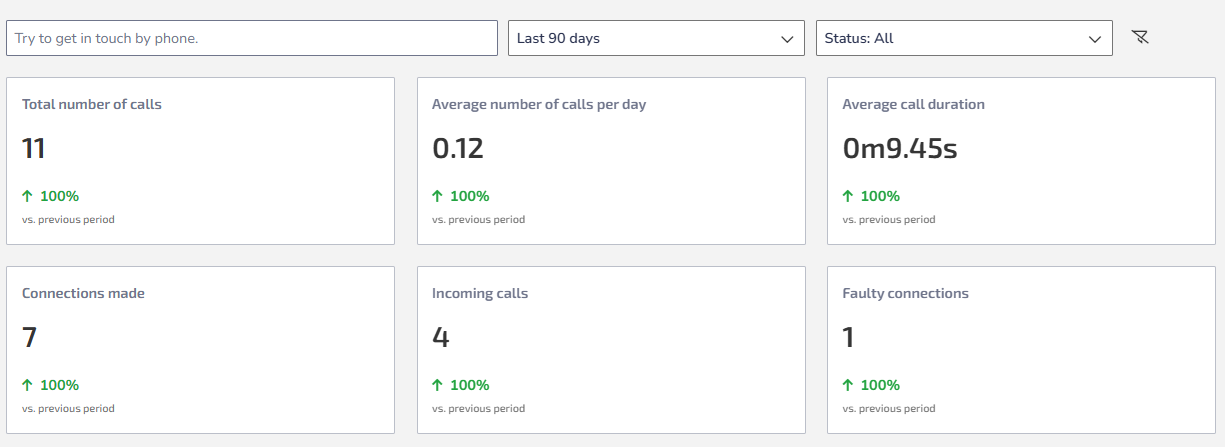
Relationship between total calls and average per day
If total calls are low and the daily average is also low, this may indicate low operational volume or occasional use of the calling feature. A high total combined with a consistent daily average may indicate frequent use of the voice channel as part of the service strategy.
Comparison between outbound and inbound calls
If there are more outbound calls than inbound ones, the operation may be acting more proactively, such as conducting follow-ups or negotiations.
If there are more inbound calls, the channel may be primarily used for support or resolving customer-initiated demands.
Analysis of failed calls
Occasional failed calls may occur due to connection issues or unavailability. If the number of failed calls is proportionally high compared to the total calls, it may indicate recurring infrastructure or connection instability issues.
Average call duration
A very low average duration may indicate quickly interrupted calls or short, objective interactions. A higher average duration may indicate more complex service interactions, negotiations, or detailed explanations.
Analysis should always consider the operational context (support, sales, retention, etc.).